NASA Solves Bennu's Rocky Surface Mystery — Boulders Are Riddled with Cracks
X-ray CT scans of OSIRIS-REx samples reveal that Bennu's boulders contain extensive internal fracture networks, finally explaining why this boulder-covered asteroid has surprisingly low thermal inertia.
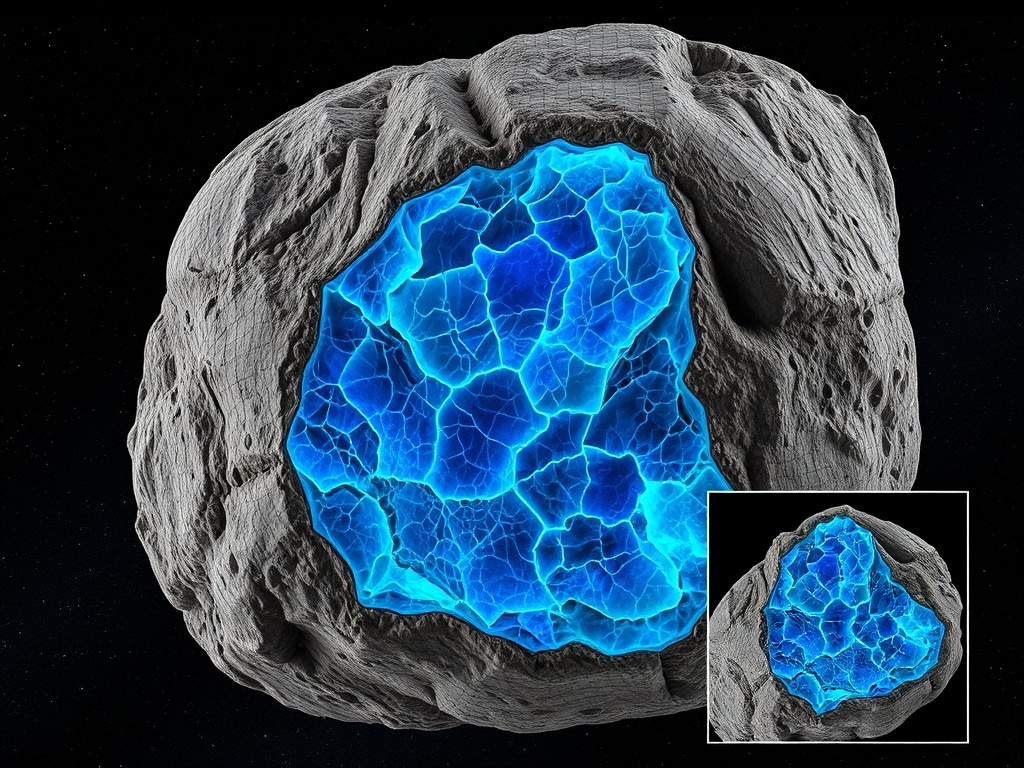
A major puzzle in asteroid science has finally been solved. A new study published March 17, 2026 in Nature Communications reveals that Bennu's boulders—which cover much of the asteroid's surface—are riddled with extensive internal fracture networks. Using high-resolution X-ray computed tomography (CT) scans of samples collected by NASA's OSIRIS-REx spacecraft, researchers discovered that Bennu's rocks are far more fragmented and porous than previously assumed.
Solving a Decades-Old Mystery
For years, planetary scientists had puzzled over one of Bennu's strangest characteristics: despite being covered with large boulders, the asteroid has unusually low thermal inertia. Thermal inertia—the resistance to temperature change—should be high on a boulder-covered body because solid rock resists rapid heating and cooling. Yet Bennu's surface responded to sunlight like a sandy desert, not a rocky landscape.
The answer lies beneath the surface. The new study shows that Bennu's "boulders" are not solid rocks, but rather heavily fractured blocks riddled with internal cracks and void spaces. These fractures dramatically reduce the thermal conductivity of the material, preventing heat from conducting deeper into the rocks. The surface heats and cools rapidly just like regolith (loose sand), despite the presence of visible boulders.
What the CT Scans Revealed
Using X-ray CT scanning—the same technology used in medical imaging—researchers created three-dimensional maps of the interior structure of Bennu samples. The results were striking: the boulders examined showed extensive networks of cracks penetrating from the surface down through the rock's interior. Many cracks were not visible from the outside, revealing a level of internal fragmentation that would have been impossible to detect through optical imaging alone.
The fracture patterns suggest that Bennu's boulders have experienced significant impact damage and thermal cycling over billions of years. The asteroid's parent body may have experienced impacts that shattered the rocks, and billions of years of thermal stresses from the Sun have propagated these fractures, creating a highly porous interior beneath an often-deceptive exterior appearance.
Why This Matters for Asteroid Science
This discovery transforms our understanding of how asteroids evolve over time. It reveals that asteroids are not static, unchanging bodies, but dynamic environments where mechanical weathering and thermal stresses continuously modify rock structure. The highly fractured nature of Bennu's boulders suggests that small asteroids are constantly breaking down—a process called "regolith gardening"—where impacts and thermal cycling gradually reduce solid rocks to smaller fragments.
For planetary defense, this finding has important implications. When planning asteroid deflection or sample collection missions, engineers must account for the fact that asteroids may be far more fragmented and less stable than surface appearance suggests. Touching down on or impacting an asteroid could trigger unexpectedly large-scale fragmentation if the surface is only a thin crust over heavily fractured material.
The Bigger Picture
Bennu continues to teach us that appearances can be deceiving in space exploration. What looks like a solid, boulder-covered asteroid is actually a constantly evolving landscape of fractured, porous rocks. This research underscores the critical importance of in-situ sample analysis and advanced imaging techniques. Only by bringing actual material back to Earth and subjecting it to sophisticated scientific tools could researchers solve this decades-old puzzle.